Insights
Nature, risk and the financial architecture of resilience
Nature finance starts with ecology, but it quickly becomes a question of economics, risk and financial architecture.
These essays explore how functioning natural systems create economic value, how degradation transmits into financial loss, and what has to happen before that value can support dependable cashflows and institutional investment.
For readers new to the work, Start here follows one route through the argument, from ecological function and physical risk through valuation, attribution, contracting, aggregation, underwriting and pricing, to market architecture.
Start here
One route through the argument
This sequence follows how the argument developed, not the order the essays were published. Each piece builds on the one before.
- Function
- Risk
- System failure
- Valuation
- Cashflow
- Geography
- Attribution
- Contract
- Performance
- Aggregation
- Underwriting & pricing
- Market architecture
-
Function
Under pressure, pushing prices up, empty shelves
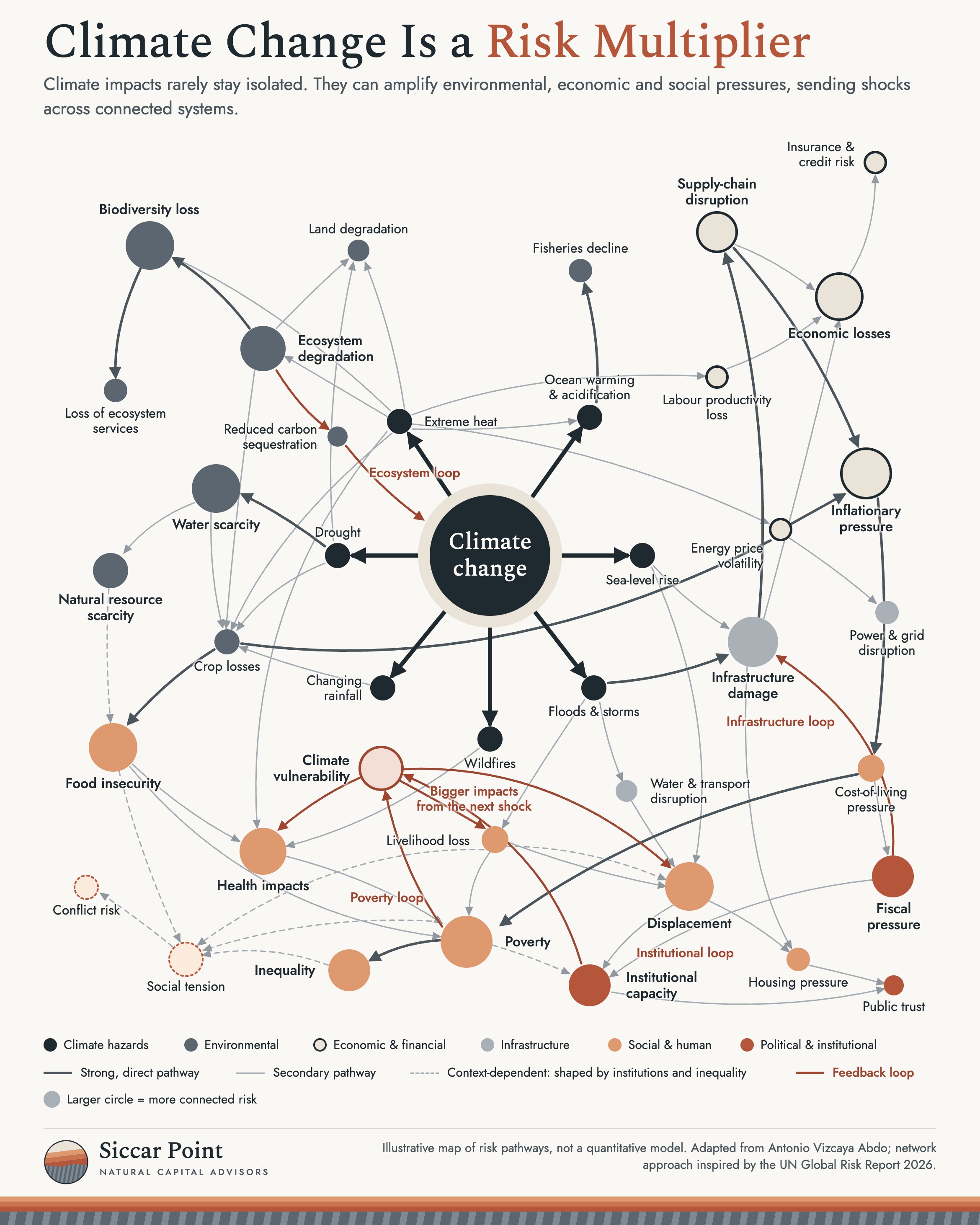
Ecosystem services are productive infrastructure, and when they degrade the costs often land far from where the damage happened.
Read article -
Risk
The storm approaching – nature as infrastructure
Nature as protective infrastructure that can reduce physical and financial loss.
Read article -
System failure
Stock damage vs flow failure
Why the failure of ecosystem-service flows can matter more than physical damage to an asset.
Read article -
Valuation
Ain’t no mountain high enough, ain’t no discount rate low enough
Why conventional valuation struggles with long-lived ecological systems that cannot simply be replaced.
Read article -
Cashflow
Why nature finance keeps stalling at credit, and what to do about it
Ecological value, financial value and investable cashflow are different things, and the gap between them is where deals stall.
Read article -
Geography
The catchment doesn’t average
Financial analysis has to follow the physical geography of how catchments and landscapes work.
Read article -
Attribution
Critical natural assets in the UK & Ireland - a map is not a market
Mapping critical natural assets is not the same as finding the beneficiaries who might pay for them.
Read article -
Contract
The contracting decade?
The financial architecture needed to turn ecosystem-service benefits into durable claims and revenue.
Read article -
Performance
The missing contract
Paying providers for the services and performance they can deliver, rather than for outcomes they cannot control.
Read article -
Aggregation
Standardise the wrapper, not the ecology
How varied ecological projects can become legible to institutional investors without pretending the ecology is interchangeable.
Read article -
Underwriting & pricing
The missing forward curve
Why resilience needs forward-looking physical-risk information before it can be priced and underwritten.
Read article -
Market architecture
Who owns the challenge? The market is growing, but what exactly are we financing?
Nature finance may finally be scaling. The harder question is whether we are financing nature’s assets, or the functions those assets actually perform.
Read article
Latest insights
Recent writing
Who owns the challenge? The market is growing, but what exactly are we financing?
Nature finance may finally be scaling. The harder question is whether we are financing nature’s assets, or the functions those assets actually perform.
Markets & contracts
Read articleHow to live on Earth: perhaps the problem isn’t that nature has no price
Financing nature is not the same as financialising it. The asset worth financing is the functioning system, not a pile of separable services.
Nature as infrastructure
Read articleMusic to my ears – what I heard at COP17
What I heard at COP17: nature increasingly described as water infrastructure, across the programme.
Nature as infrastructure
Read articleCOP17: maybe the nature finance gap isn’t really a finance gap?
From COP17 in Yerevan: perhaps the nature finance gap is less about money than about what we contract for.
Markets & contracts
Read articleWho should underwrite the river?
We can contract for actions on a river, but who carries the risk that the outcomes don’t arrive?
Risk & resilience
Read articleWhen capital is scarce, nature infrastructure becomes more valuable
As water companies struggle for capital, nature infrastructure that defers or avoids capex becomes more valuable.
Valuation & investment
Read article
Explore by theme
Speaking
Talks and panels
Nature finance in the UK: perspectives from investment leaders
A conversation with two large institutional investors about nature finance in the UK.
Moderator: Eoin Murray
Nature Finance UK Conference 2026
Building investable natural capital markets for marine nature
Panel on what it will take to build investable markets for marine nature.
Moderator: Eoin Murray
Blue Finance 2026
Saltmarsh finance workshop
Leading the project-preparation and investability table at a workshop on financing saltmarsh restoration, with Athena Blue.
Table lead: Eoin Murray
Blue Finance 2026
A deep dive on natural capital
Panel discussion on natural capital as an investment theme.
Panellist: Eoin Murray
London Impact Investing Network (LIIN) · Imperial Business School, London
Investing in Nature: building a sustainable market
Panel discussion on what it will take to build a lasting market for private investment in nature.
Panellist: Eoin Murray
Office for Investment · M Shed, Bristol
Turning nature-positive ambition into investable opportunities
Panel at the UK–Armenia Nature Finance and Business Dialogue, held during CBD COP17.
Panellist: Eoin Murray
UK–Armenia Nature Finance and Business Dialogue · Yerevan, Armenia
Business and Biodiversity Forum, closing panel
Closing panel of Business Day at the UN biodiversity conference.
Panellist: Eoin Murray
CBD COP17 · Yerevan, Armenia
Nature restoration finance
The UK private-sector investment case for nature, the barriers to scale, and lessons from New Zealand.
Panellist: Eoin Murray
Biodiversity Law and Governance Day · Hogan Lovells · Online
The $200 billion question: implementing the GBF’s ambition through practical investor steps
Panel on the practical steps investors can take to deliver the Global Biodiversity Framework’s ambition, held during CBD COP17.
Panellist: Eoin Murray
IIGCC · Yerevan, Armenia
Explainers
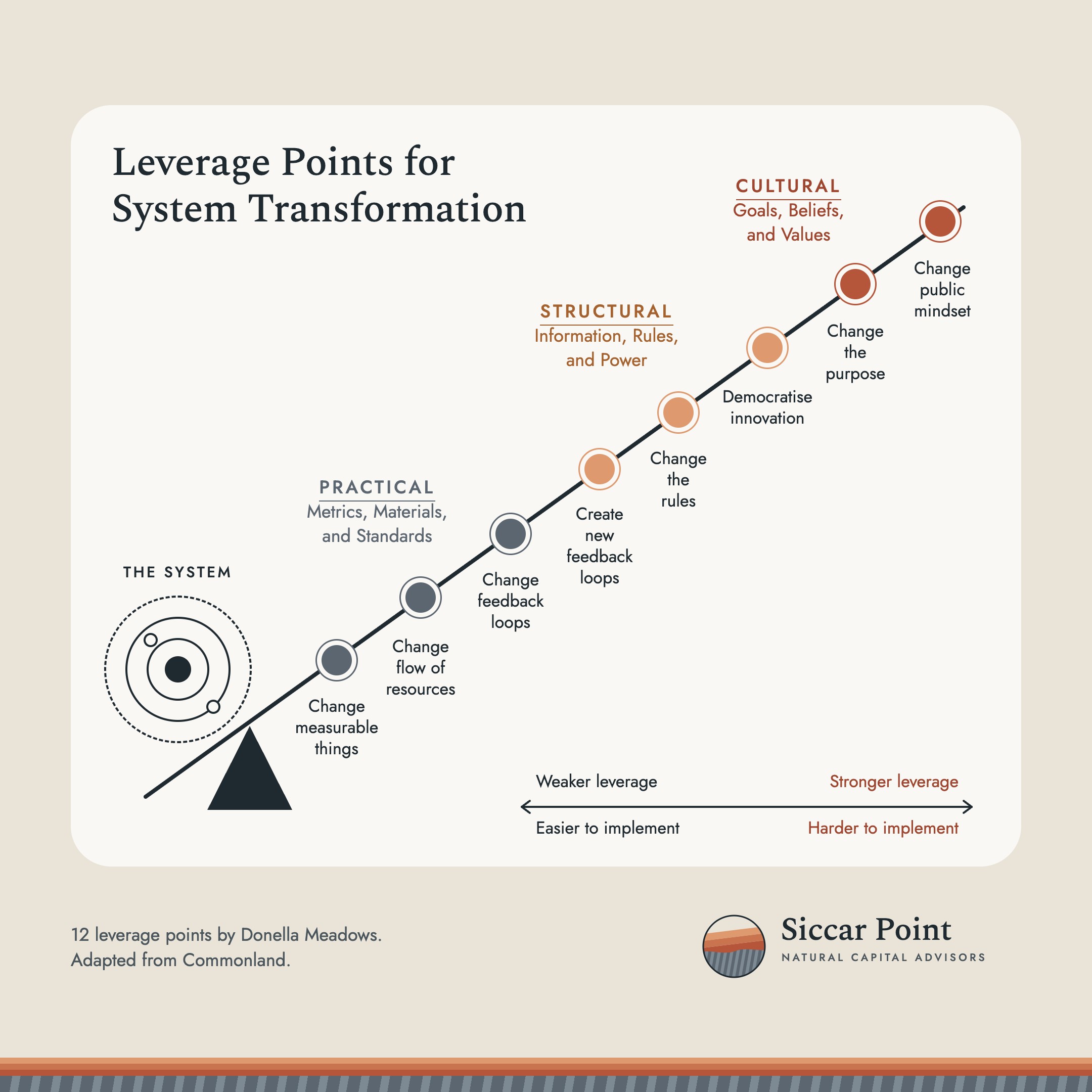
The ideas behind our work, in one picture each.