Services

What we do

We bring investment, commercial and scientific experience to the hardest part of nature finance: turning restoration into projects with a sound commercial case.

Project preparation

Most nature projects stall long before they are ready for funding. We help project developers, landowners and partnerships get them there.

  • Finance-readiness assessments
  • Business plans and revenue models
  • Governance, delivery partners and risk allocation
  • Blended funding strategies with public and philanthropic funders
Nature markets and revenue strategy

A restoration project needs people who will pay for what it delivers. We help identify them and design the commercial arrangements.

  • Carbon, biodiversity net gain and nutrient markets
  • Outcome contracts with water companies, flood authorities and other regulated buyers
  • Pricing against the cost of grey alternatives
  • Stacking revenues without double counting

Natural capital accounting and nature risk

You cannot manage what you have not measured. We help organisations see the natural assets they own or depend on, and what is at stake if those assets decline.

  • Natural capital baselines and asset registers
  • Valuation of ecosystem services
  • Nature-related risk and dependency analysis
  • Support for nature-related disclosure and reporting

Research, policy and strategy

Independent thinking on how nature finance markets work and how they could work better.

  • Market design and policy analysis
  • Briefings and workshops for boards, trustees and public bodies
  • Appraisal methods for long-lived natural assets
  • Speaking and convening

What we don’t do

We do not advise on or recommend particular investments, arrange investment transactions, introduce investors to opportunities, or manage money. Siccar Point is not authorised or regulated by the Financial Conduct Authority. Where a project needs regulated services, we work alongside appropriately authorised firms.

Where we work

Landscapes with a revenue case

River catchments

Natural flood management that slows water upstream and protects homes, businesses and infrastructure below.

Upland peat

Restoring degraded peatland to lock in carbon, hold water and bring back habitat.

Saltmarsh and coast

Blue carbon, coastal defence and nursery habitat for fisheries.

Farmland and woodland

Nature recovery that works alongside productive land use.

Managing impacts

Avoid, minimise, restore, then offset

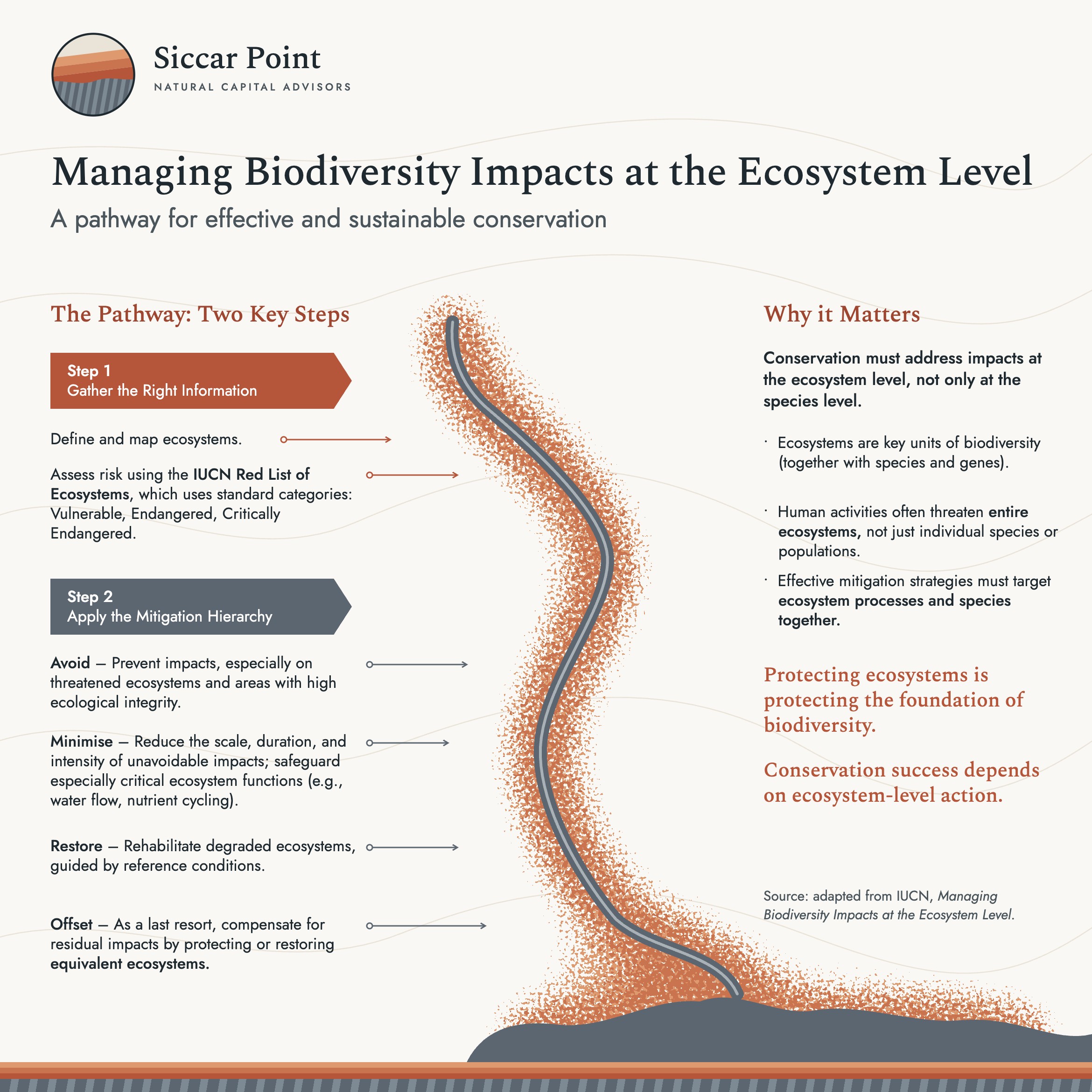
Credible nature strategies start with the mitigation hierarchy, applied to whole ecosystems rather than single species. We use it to help clients understand their impacts and dependencies before any money moves.

Infographic of a two-step pathway for managing biodiversity impacts at the ecosystem level. Step 1, gather the right information: define and map ecosystems and assess risk with the IUCN Red List of Ecosystems. Step 2, apply the mitigation hierarchy: avoid, minimise, restore, and as a last resort offset.
Adapted from IUCN, Managing Biodiversity Impacts at the Ecosystem Level. Open full size

How we work

Three stages, in this order

  1. Read the landscape

    Start with the land, the water and the people who manage them. What can this place deliver, and for whom?

  2. Build the revenue case

    Identify who pays for each outcome, on what terms and for how long, and test it against realistic risk.

  3. Get it ready for funding

    Bring the contracts, governance and evidence up to the standard that funders and their own advisers will expect.

Talk to us about your project